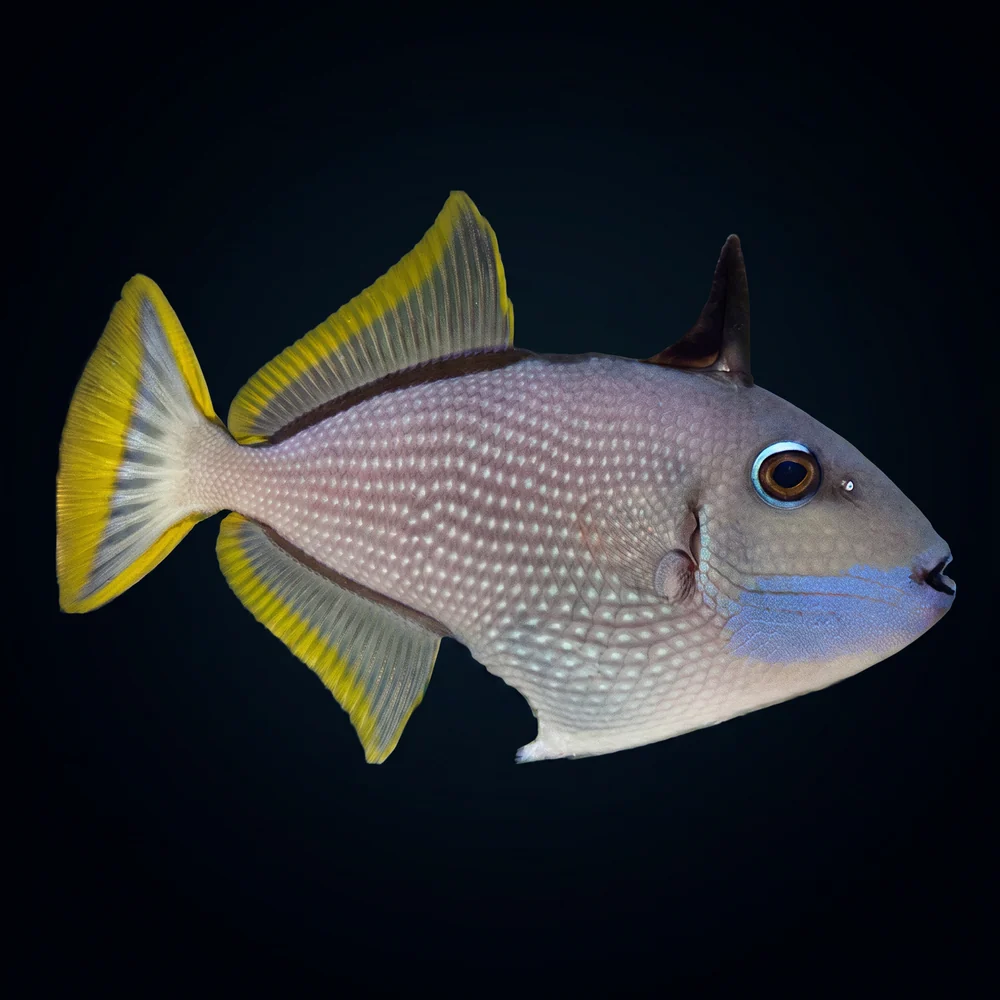
Xanthichthys auromarginatus is a deep-bodied triggerfish in grayish-brown, dusted with pale blue spots and finished with yellow-edged fins. Mature males carry the namesake dark to vivid blue patch across the chin and cheeks, while females lack that marking and show more subdued fin margins. The species ranges widely across tropical Indo-Pacific reefs, from Mauritius through northern Australia to southern Japan, Hawaii, and the Society Islands, where it hovers in loose groups above current-swept seaward drop-offs and ledges. Documented maximum length is roughly 12 inches.
Adult housing should begin at 180 gallons, with the emphasis placed on horizontal open-water swimming room rather than dense decor. Build rockwork that includes caves and crevices deep enough for retreat, since a newly introduced fish will often wedge itself into a crevice and lock in place with its dorsal spine. Expect loose landscaping to be shifted or rearranged over time, so secure structures rather than relying on stacked rubble. Because the natural habitat is exposed to steady current, provide brisk water movement, and pair generous volume with filtration capable of handling frequent substantial feedings. These fish can also spit water beyond the rim, so protect exposed wiring and electrical connections near the tank.
In the wild this triggerfish takes zooplankton above the reef, with copepods forming a significant portion of its intake. Captive diets should be varied and predominantly meaty: mysis and fortified brine shrimp, krill, squid, chopped fish and shrimp, and clam flesh all suit it well, along with quality frozen or prepared carnivore rations. Hard-shelled marine foods are worth including because they help wear down the teeth. Nutrient-dense pellets are usually accepted, and some individuals will also pick at dried marine algae.
Feed two or three times daily, or otherwise divide the ration into frequent small meals, since this is an eager and energetic feeder with a fast metabolism. Most specimens take prepared food readily after a short settling period. A freshly introduced fish may retreat into the rockwork for several days, and very aggressive tankmates can intimidate it away from the feeding station, so watch that it is actually receiving its share during the first weeks.
Mysis ShrimpFortified Brine ShrimpKrillSquidChopped FishClam FleshHard-Shelled Marine FoodsCarnivore Pellets
Among the triggerfishes this is one of the milder species, though it remains a confident, semi-aggressive animal that holds its own in an established community. Wild individuals form loose aggregations and distinct pairs. In the aquarium, the safest approach is a single specimen or an established male-and-female pair; some keepers maintain one male with multiple females in very large systems, but multiple males should never be housed together. Tankmates should be similarly sized and reasonably assertive, as extremely docile or slow-moving fish may be harassed, while highly aggressive species can bully a newcomer. Food competition is worth planning for given how vigorously this fish feeds.
Treat it as reef-safe with caution. Corals, including soft and stony species, are generally ignored, and sessile invertebrates face less risk here than with most triggerfishes, which makes the species a candidate for carefully chosen reef systems. Mobile and exposed invertebrates are the real concern: ornamental shrimp, hermit crabs, snails, sea urchins, and feather-duster worms are all plausible targets. Small fish may occasionally be pestered as well, so stock accordingly and accept that a cleanup crew of desirable invertebrates may gradually be reduced.