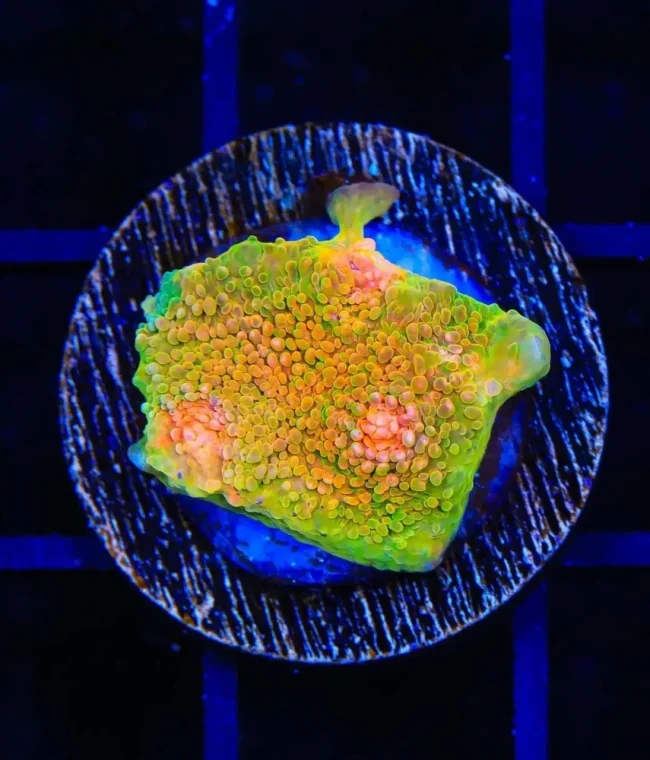
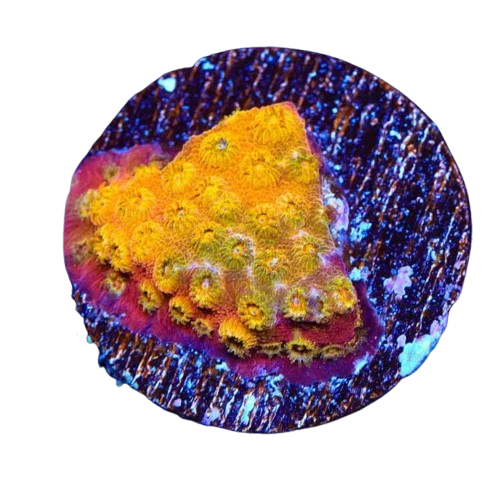
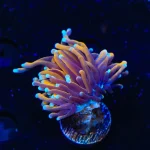
Mummy Eye Chalice Coral displays a flat, plating skeleton with bright orange “eyes” set in a contrasting base. Echinophyllia sp. is a stony plating coral that does best under low to moderate light and gentle to moderate water flow. It is primarily photosynthetic via symbiotic algae but benefits from occasional small meaty feedings, which can support growth and color. Place it on a stable surface with space around it, as it can extend sweeper tentacles at night and sting nearby corals.
Mummy Eye Chalice Coral (Echinophyllia sp.) prefers low to moderate light (PAR ~75–150) and gentle, indirect flow that is strong enough to keep detritus from settling without lifting tissue. Start it low and light-acclimate over 1–2 weeks using reduced intensity or screen layers to avoid bleaching. Place on stable rockwork in the lower to mid portions of the tank; avoid abrasive sand contact. Allow 3–6 inches of space from neighbors—this coral is semi-aggressive and can extend short sweeper tentacles and mesenterial filaments at night. Feed small meaty foods (mysis, rotifers, finely chopped seafood) or quality coral foods 1–2 times weekly, preferably after lights out when feeding polyps are visible; target feed lightly to support growth and coloration without spiking nutrients.Maintain stable water: temperature 76–79°F (24.5–26°C), salinity 1.025–1.026 (35 ppt) with an auto top-off, pH 8.1–8.4, calcium 400–450 ppm, alkalinity 8.0–9.5 dKH (stability is key), magnesium 1300–1400 ppm, nitrate 2–15 ppm, phosphate 0.03–0.08 ppm. Test weekly and adjust slowly; this species is sensitive to rapid alkalinity or salinity swings. Inspect and dip new pieces to prevent pests (flatworms, nudibranchs). Signs of trouble: bleaching (too much light), tissue recession from the edges (alk swings, pests, or direct flow), slime/brown jelly (bacterial—frag away affected areas and improve flow). Keep detritus off the rim with periodic baster blasts, and avoid direct stings from torches, hammers, or aggressive favias. Drip acclimate 20–30 minutes on arrival and keep hands and tools clean to prevent chemical irritation.
Why does my Mummy Eye Chalice shift from neon green with orange eyes to a duller, brownish base under the same lights?
Echinophyllia can bank or shed pigments in response to spectrum and nutrient balance, not just PAR. Excess blue with ultra-low nitrate/phosphate often washes green fluorescence, while warm-spectrum peaks (red/amber) push browning. Target a moderate PAR (80–150), maintain NO3 5–15 ppm and PO4 0.03–0.08 ppm, and avoid sudden spectrum changes. Stability for 3–4 weeks usually restores color.
The rim is receding even though alk, calcium, and magnesium are stable. What’s a likely cause and fix?
Edge recession on this chalice often stems from localized irritation: detritus accumulation on the cupped surface, stinging from nearby LPS, or nocturnal sweeper contact. Increase laminar, low–medium crossflow to keep the surface clean, siphon debris weekly, and ensure 3–4 inches of clearance. A narrow ring of cyano on the rim is a giveaway—reduce organics, not just increase flow.
How do I feed without causing bacterial film or tissue lifting on the eyes and ridges?
Feed small particle foods (reef roids, fine mysis slurry) 1–2 times weekly at night when feeders extend. Briefly pause flow to target feed, then resume gentle flow after 5–10 minutes to clear leftovers. Oversized chunks cause prolonged contact and irritation. If film appears next day, cut portions in half and consider a post-feed turkey baster puff to remove residue.