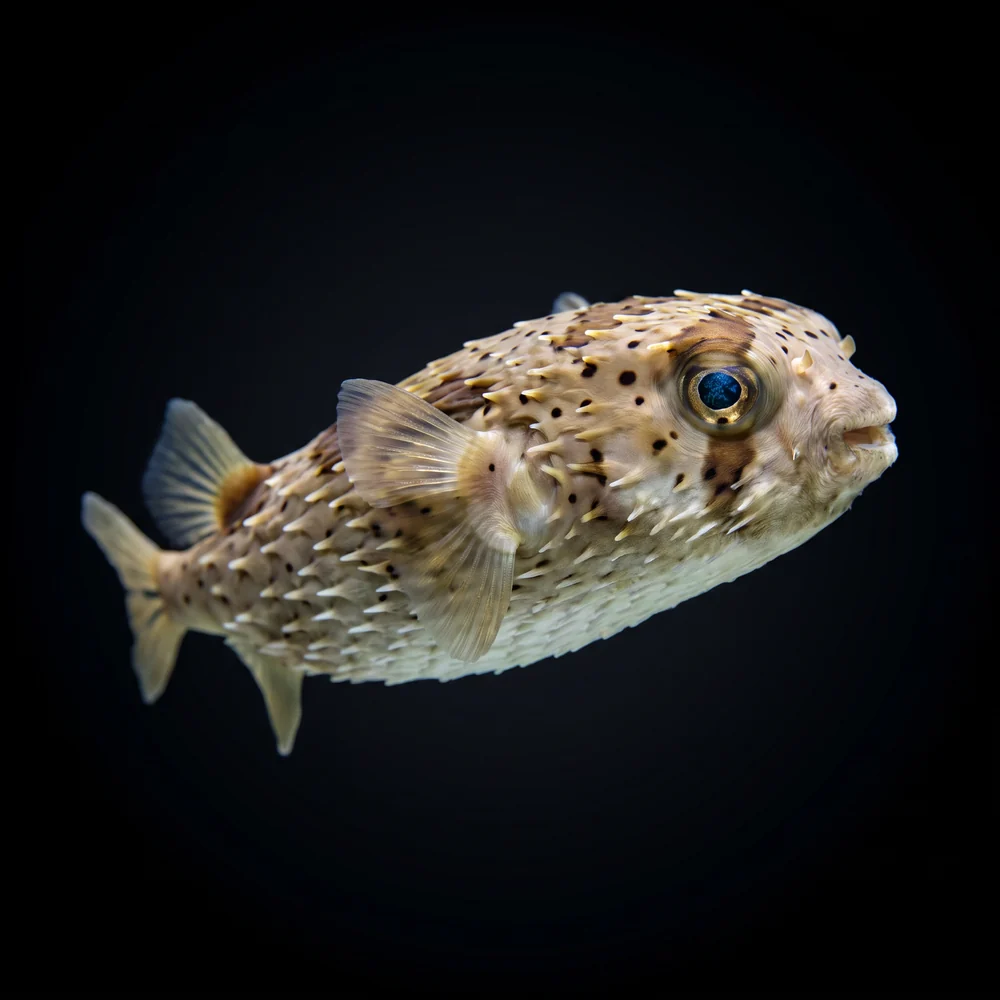
The Porcupine Puffer, Diodon holocanthus, is a heavy-bodied porcupinefish built around an oval frame, oversized eyes, and a fused beak strong enough to crush shelled prey. Long spines lie flat against the body until the fish inflates defensively, at which point they stand erect. Adults are pale brown to olive, marked with dark body blotches, scattered smaller black spots, and brown bars running across the eyes; the unspotted fins separate this species from the similar Diodon hystrix. The species is distributed through circumtropical oceans, where it occupies shallow reefs as well as rocky ledges, seagrass beds, and open soft-bottom terrain. Most individuals reach roughly 8 to 14 inches, though the species can attain 20 inches.
Because of that potential size and the fish’s need for both shelter and cruising room, plan on a 180-gallon or larger aquarium for an adult. Build substantial rockwork that includes caves, cracks, crevices, and ledges where the puffer can settle during the day, but leave broad, unobstructed lanes open for swimming. A fish-only system paired with a strong protein skimmer suits this species best, since a large messy carnivore places a heavy load on filtration. Never provoke the fish into inflating for display purposes; inflation is a stress response, not a trick.
Handle this puffer with a net or container rather than exposing it to air, and give it a mature, stable system. Care requirements sit at a moderate level: the species is hardy once settled, but its size, appetite, waste output, and dental maintenance all demand consistent attention from a keeper who is prepared for a long-term commitment to a large predatory fish.
In the wild, Diodon holocanthus hunts after dark for hard-bodied benthic animals. Snails, bivalves, sea urchins, hermit crabs, other crustaceans, sea stars, and worms all fall to that powerful beak, which is why the species is best treated as a dedicated carnivore. Captive menus should mirror that natural intake with varied meaty items such as squid, krill, clams, and hard-shelled shrimp.
Hard-shelled foods are not optional enrichment. The beak-like teeth grow continuously, and regular abrasion from shelled shrimp, clams, and similar items keeps them worn down to a functional length. Offer meaty foods multiple times daily, rotating between soft and shelled items so the fish receives both nutritional variety and the mechanical wear it needs. Watch the beak over time and increase the proportion of shelled prey if the teeth begin to look long.
SquidKrillClamsHard-Shelled ShrimpMussel Meat
This is a deliberate, slow-moving fish that spends daylight hours tucked into a cave, crevice, or shaded overhang and becomes active as a forager after dark. Adults are typically solitary, while juveniles and subadults may gather in small groups. Temperament is semi-aggressive, and individuals have been known to nip at the fins of tankmates, so choose companions carefully.
Suitable tankmates are robust, even-tempered fish that are larger than the puffer and will not harass or outcompete a poor swimmer at feeding time. This species is not reef safe. It readily consumes ornamental shrimp, crabs, snails, clams, urchins, and sea stars, meaning a conventional cleanup crew will simply become food, and it may also pick at soft corals. A fish-only aquarium is the appropriate home.